Strong DIY Pest Controls at Capy.co.uk

Welcome to Capybara Pest Control Supplies and Services. Any problem please contact us on 01905 35 45 49 or help@capy.co.uk

Ant killer solutions! NB: We do not supply ant eaters!

Visit www.capy.co.uk for ant pest control solutions! Or call 01905 354549 or email help@capy.co.uk

Professional bed bug solutions!

Bud bug pest solutions with Capybara! For help visit www.capy.co.uk or contact us via email help@capy.co.uk or 01905 354549

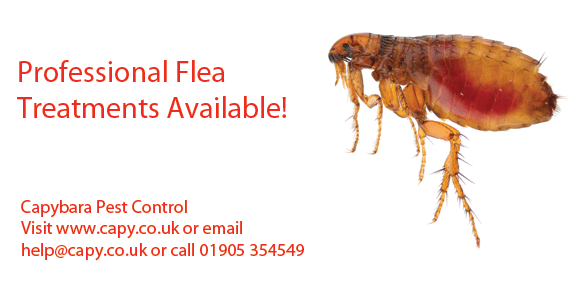
Cat Fleas, Dog Fleas, Capybara has the solution!

Get rid of these nasty biting insects quickly and cost effectively with Capybara!

Showing posts with label moth. Show all posts

Wednesday, November 30, 2011

Virus Gets Gypsy #Moth High


The caterpillar of the European gypsy moth climbs trees by night to feed on leaves but descends to the in relative safety of the ground during the day and to moult. However when infected by a baculovirus the caterpillar changes this behaviour, no longer returning to the ground but  remaining high in the tree where the virus releases enzymes that liquifies the caterpillar from the inside out and the infected liquid rains down to be widely distributed from the tree's canopy. Scientists at Pennsylvania State University believe that a  gene in the virus interferes with the hormone that triggers moulting in the caterpillars which usually takes place on the ground.

Monday, November 7, 2011

Museums Moth Misery

Some of our greatest collections of artefacts in museums all over the country, are under attack from various moths and beetles. Irreplaceable historic objects like costumes, tapestries and carpets in virtually all of Britain's national museums are being threatened as infestations reach unprecedented levels. These textiles are particularly vulnerable as they are composed of natural fibres like wool, silk, cotton, hairs and skins and many were dyed using plants or even crushed insects, making them ideal food for the moths and beetles. Pest specialists are using a range of techniques such as pesticides, lures, traps and even freezing some items, to help save our fragile heritage.

Clothes moth are a pest! Buy the best clothes moth pads and other treatments at Capybara Pest Control. 

London pest services is a new division of Capybara. Click here for professional London pest control. 

Friday, October 7, 2011

Heatwave brings rare moths to UK


The recent heatwave has seen hundreds of rare moths arriving in the UK, in what experts are describing as the best migration for the insects in years.
A variety of species, many of which are usually found in the Mediterranean, have turned up in the UK and Ireland as a result of the warm weather and southerly winds, Butterfly Conservation said.


Moths are only a problem when they choose to dine in on your clothes or carpets. In that case:-

For all your clothes moth pest problem visit our web store, www.capy.co.uk

Rare flame brocade moth is established in the UK


Not all moths are bad news by any stretch of the imagination.

These are moths to cherish

The flame brocade moth appears to have started a new colony on the south coast of England.
Researchers from the charity have attributed the arrival of an unusually high number of migrant species to the recent warm weather.

They described this year's migration season as the best in years.
Just make sure they don’t dine on your clothes or carpets!!


Friday, June 10, 2011

Tim Lockley: Oldies but goodies help control moths

Tim Lockley: Oldies but goodies help control moths

A hundred years ago mothballs and cedar chests were a common sight (and smell) in American homes -- with good reason. Back then most of our clothes, curtains and carpets were made from natural fibers such as wool. Even down here in the Deep South, people wore winter woolies to keep warm, but these items had a dreaded enemy: the clothes moth.
Today, they seem to be making a comeback. In Great Britain, people are suffering from a veritable plague of the common clothes moth (Tineola bisselliella). The British ministry responsible for pest control had to be closed down for fumigation because of these moths.
Clothes moths like the dark and seldom come to light. The caterpillars spend their time in the dark recesses of wardrobes, drawers and closets, munching on silken and woolen clothes. If your woolies aren’t available, they will just as happily eat fur, felt, sheepskin, feathers, the horsehair stuffing of antique furniture and even the bristles on brushes. A sweaty armpit or food-stained garments make their meal even more enjoyable, so much so that they will sometimes feed on cotton fabrics. An artist in London was hospitalized for two months and, when she was discharged, came home to find that her artist brushes had all been nibbled down to nubs by the voracious moths.
Our ancestors knew how to handle these pests, and their methods still can be used to good effect. Twenty or so years ago, my father made cedar chests for his kids and grandkids. I’m not certain what my children are doing with theirs, but for years we’ve used ours to store the quilts my mother made. Cedar contains an oil that can kill the moths and their larvae. Eventually, these oils dissipate and the wood becomes useless. In a tightly sealed, well made chest, this can take years. If you can still smell the cedar, it should still be active Cedar balls that are hung in a closet, on the other hand, don’t last very long. If your closet is constantly being opened and closed, their efficacy can fall to near zero. If the scent of cedar isn’t to your liking, try lavender bags.
Mothballs are made from naphthalene or paradichlorobenzene and supply only a partial solution. Like the cedar balls, they need to be in a closed space so that the vapors can build up. If the space isn’t well sealed, the fumigant will leak out and, while it might repel the adult moths, the caterpillars will just keep on feeding and causing damage. In addition, mothballs have, to some, a bad odor that is difficult to air out. They are also poisonous and have to be kept away from children and pets.
Dry cleaning and washing in hot water will kill all stages of the pest, eggs to adults. You can protect carpets and rugs by moving the furniture and vacuuming them. Remove and throw away the bag afterwards. The larvae can live and grow on the fibers you sucked up with them. For items you don’t wear often or wear only seasonally, invest in some garment bags. Clean the garments well before you store them.
Left to their own devices, these critters will continue their orgy of feasting and reproduction, causing continuous damage to your garments. Unless you want to be forced to wear only synthetics, you’ll need to keep a watchful eye on your sartorial delights. That cashmere sweater you love so much? They love it more than you do.
Tim Lockley, a specialist in entomology, is retired from a 30-year career as a research scientist for the U.S. Department of Agriculture. To have him answer your individual questions, please send a stamped, self-addressed envelope to Tim Lockley, c/o Sun Herald, P.O. Box 4567, Biloxi, MS 39535.


Read more: http://www.sunherald.com/2011/06/09/3183427/oldies-but-goodies-help-control.html#ixzz1OrWzsttw

www.sunherald.com

Twitter Delicious Facebook Digg Stumbleupon Favorites More